Panama Commercial Real Estate: The Complete Investor's Guide
Panama commercial real estate offers foreign investors full ownership rights, USD-denominated income, territorial taxation, and access to one of the most strategically positioned economies in the Western Hemisphere. The Panama Canal, the Colón Free Trade Zone — the second-largest in the world — and a growing concentration of multinational regional headquarters create sustained, structural demand across office, retail, and industrial asset classes. This guide covers everything a foreign investor needs to evaluate, acquire, and manage commercial property in Panama: market benchmarks, legal frameworks, financing options, due diligence requirements, and sector-specific risk analysis. For a comprehensive overview of Panama's real estate landscape beyond commercial property, see our guide to Panama real estate law for foreign investors, which covers the legal foundations applicable across all property types.
Why Panama for Commercial Real Estate Investment
Panama is one of the very few countries in Latin America that uses the US Dollar as its official circulating currency — there is no Balboa note in circulation, only coins. That single structural fact eliminates the currency risk that erodes returns in peso- or real-denominated markets across the region. Combined with a territorial tax system that exempts all foreign-sourced income from Panamanian taxation, the jurisdiction offers a baseline of financial predictability that very few emerging markets can match.
The macroeconomic fundamentals are equally compelling. Panama's GDP grew at approximately 7.3% in 2023, recovering strongly from the pandemic-era contraction, and the International Monetary Fund projects sustained growth above 4% annually through the late 2020s. The Panama Canal alone generates over $2.4 billion in annual revenue for the state, and the expanded third set of locks — inaugurated in 2016 — has nearly doubled cargo capacity, attracting a new wave of logistics operators, shipping companies, and multinational supply-chain managers who require permanent commercial infrastructure in Panama City.
The Colón Free Trade Zone facilitates over $28 billion in annual merchandise trade, making it the largest free trade zone in the Americas and the second-largest globally after Hong Kong. This concentration of commerce creates constant, non-cyclical demand for warehousing, distribution centres, and commercial services infrastructure along the Panama City–Colón corridor.
Dozens of Fortune 500 companies — including Dell, Caterpillar, Procter & Gamble, and Adidas — maintain their Latin American regional headquarters in Panama City. Their presence anchors demand for grade-A office space and creates a deep pool of creditworthy corporate tenants, a factor that directly improves the risk profile of office investment relative to other regional capitals.
Finally, Panama's legal system affords foreign investors the same property rights as Panamanian nationals. There are no restrictions on foreign ownership of commercial titled property, no repatriation controls on rental income or sale proceeds, and no foreign exchange controls of any kind. These are not minor administrative conveniences — they are the structural conditions that make institutional-grade commercial investment viable.
Considering a commercial property acquisition in Panama? Our attorneys advise on corporate structures, due diligence, and closing from a single point of contact.
Request a Legal ConsultationNo obligation. Response within one business day.
Commercial Property Types: Offices, Retail, and Industrial
Office Space
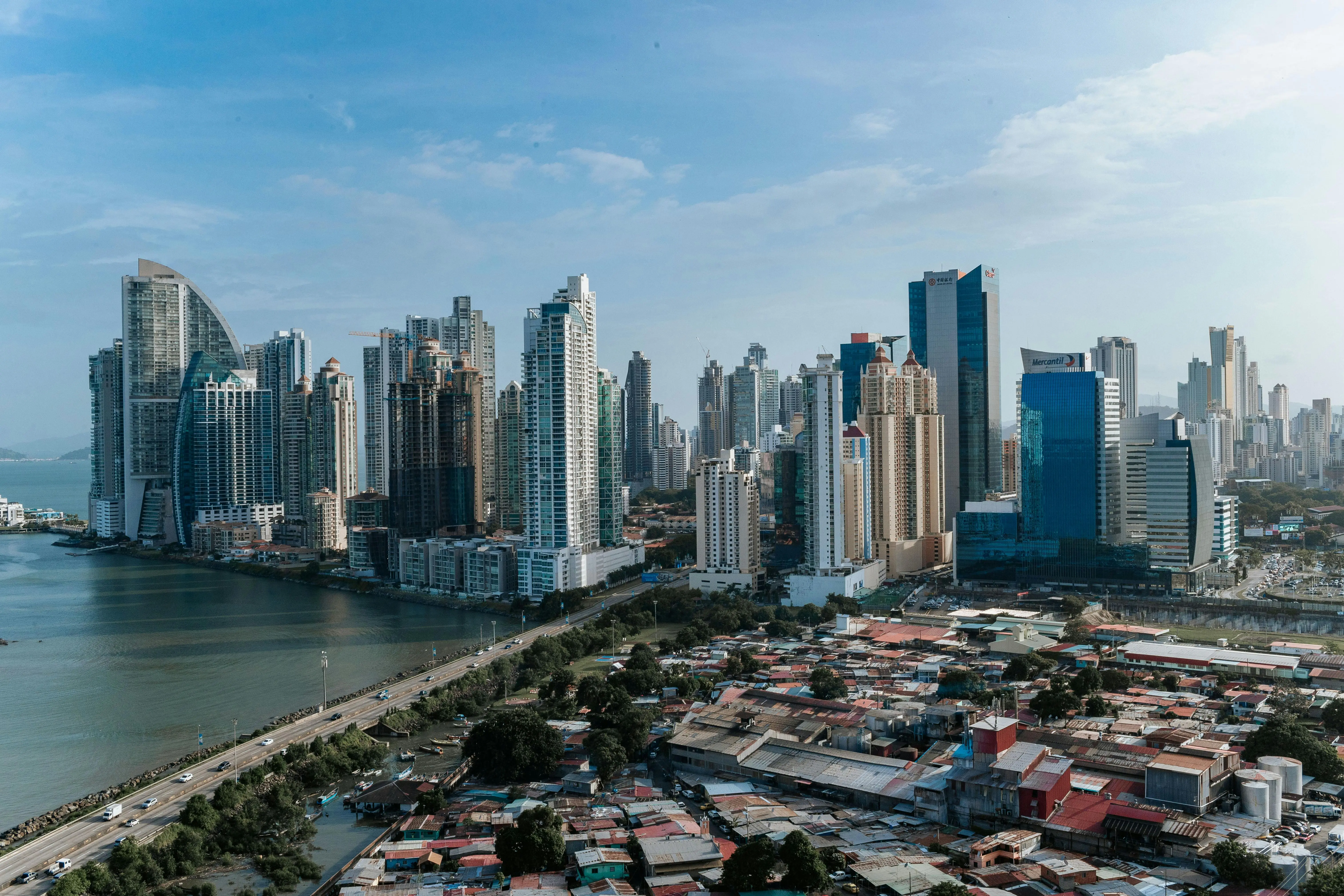
Panama City's office market is concentrated in a corridor running from Punta Pacifica through Marbella, Obarrio, and San Francisco to Costa del Este and Santa María. Costa del Este has emerged as the dominant grade-A submarket: it is home to the majority of multinational regional headquarters and houses the city's most modern commercial towers, with floor plates typically ranging from 800 to 2,500 square metres. Asking rents in Costa del Este for grade-A space range from approximately $22 to $30 per square metre per month, while grade-B space in Marbella and Obarrio trades at $14 to $20 per square metre per month.
The office market experienced elevated vacancy in the 2018–2022 period, partly due to oversupply from speculative development and partly due to the pandemic. By 2024–2025, absorption had improved materially as nearshoring trends and the continued expansion of the financial services sector drew additional corporate occupiers. Investors should distinguish between grade-A towers with institutional tenants and older grade-B stock, which carries meaningfully higher vacancy risk.
Retail Real Estate
Panama City has one of the highest retail square-footage-per-capita ratios in Latin America, a consequence of aggressive mall development during the 2005–2015 boom. Major retail centres include Multiplaza Pacific, Albrook Mall (the largest in Central America by footprint), Metromall, MultiCentro, and the more recent Westland Mall in the west of the city. Saturation in large-format retail is a genuine concern; investors should focus on neighbourhood retail strips, high-street units in established commercial corridors, and mixed-use ground-floor retail in residential towers, where foot traffic is more defensible. For investors also interested in the residential side of mixed-use projects, see our Panama residential real estate guide for foreigners, which covers residential property acquisition, condo law, and the intersection with commercial ground-floor units.
Strip retail and food-and-beverage units in areas such as Casco Viejo, Via Argentina, and the Obarrio–El Cangrejo corridor continue to attract local and international operators. Asking rents for high-street retail in these zones range from $25 to $50 per square metre per month depending on visibility and pedestrian volume.
Industrial and Logistics Property
Industrial property is the fastest-growing commercial segment in Panama by investor interest. The expansion of the Panama Canal has created direct demand for modern logistics facilities, cold-chain warehousing, and light-manufacturing space in the Tocumen corridor east of the city and in the Howard–Arraján corridor on the Pacific side of the former Canal Zone. Modern logistics warehouses in these areas feature clear heights of 10 to 14 metres, dock-leveller loading bays, and direct access to the Pan-American Highway and Corredor Sur.
Asking rents for industrial space in the Tocumen corridor range from $7 to $12 per square metre per month. Capital values for institutional-quality logistics assets are currently in the range of $800 to $1,200 per square metre, implying cap rates of approximately 7% to 9% — the most attractive yield profile among Panama's three main commercial asset classes.
Market Data and ROI Benchmarks by Sector
The following benchmarks are indicative for 2025–2026 and reflect market conditions in Panama City's primary commercial submarkets. They should be treated as ranges, not guarantees; individual assets will vary based on tenant quality, lease term, location, and building specification.
Capital appreciation in Panama City's prime commercial submarkets has averaged 3% to 5% per annum in USD terms over the past decade, with Costa del Este and the Tocumen logistics corridor outperforming. These figures are meaningfully lower than the double-digit appreciation sometimes cited in promotional material; investors who build their underwriting on 8% to 10% annual appreciation are likely to be disappointed. The investment case for Panama commercial real estate rests primarily on income yield and USD stability, not speculative price growth.
Legal Framework for Foreign Investors
Panama's legal framework for commercial property ownership is governed primarily by the Civil Code, the Constitution of the Republic of Panama, and a series of specific statutes including Law 93 of 1973 (as amended) for leases, and the general property registration regime administered by the Public Registry of Panama.
Foreign individuals, corporations, trusts, and foundations may own commercial titled property in Panama on the same footing as nationals, subject to a small number of constitutional limitations that apply equally to nationals and foreigners — most notably that no private titled ownership is permitted within ten kilometres of either land border of the Republic. Island property, which was historically restricted, was opened to foreign ownership and tourism concessions by a 2006 constitutional reform and Law 2 of 2006, though island acquisitions warrant project-specific legal review. For commercial real estate investors focused on Panama City, Colón, or David, these restrictions are not practically relevant.
With respect to coastal commercial property, a public maritime-terrestrial strip measured from the high-tide line cannot be privately titled; the exact width can vary by coast and regulation, so it should be verified for the specific parcel. Commercial development within the public/concession zone requires a government concession rather than a fee-simple title — a meaningful distinction that affects both financing and resale liquidity. Investors acquiring raw land for commercial development — whether on the coast or inland — should review our detailed guide to buying land in Panama, which covers the titled vs. rights-of-possession distinction, border zone restrictions, and due diligence steps that apply before any development project can begin.
The Public Registry of Panama is one of the most technologically advanced property registration systems in Latin America. All titled properties are recorded there, and searches can be conducted online through the Registry's portal. A title search reveals the current registered owner, any mortgages or liens, easements, restrictions, and the property's cadastral description. This transparency is a significant advantage for investors conducting due diligence.
Commercial leases in Panama are governed by the principle of contractual freedom and the Civil Code, with Law 93 of 1973 applying primarily to residential leases below $150 per month. Commercial leases are not subject to rent control and may be freely negotiated between parties. As noted by Chambers and Partners in their Panama real estate guide, the three main lease categories are: (a) residential leases at or below $150/month, (b) residential leases above $150/month, and (c) commercial leases — each with distinct legal treatment.
Corporate Structures and Tax Planning
Most foreign investors in Panama commercial real estate acquire property through a Panamanian Sociedad Anónima (S.A.) — the local equivalent of a corporation — rather than in their personal name. This approach offers several practical advantages: it simplifies estate planning by allowing ownership interests to transfer without a separate property deed transfer; it provides a degree of liability separation between the investor and the asset; and it facilitates the addition of co-investors or lenders as shareholders or creditors without triggering a property transfer tax.
An S.A. can be incorporated in Panama within two to five business days. It requires a minimum of three directors (who may be nominees), does not require Panamanian shareholders, and has no minimum capital requirement. Annual maintenance costs — including the registered agent fee and annual franchise tax — typically run $500 to $1,200 per year depending on the service provider. For investors who also require asset protection or succession planning, a Panama Private Interest Foundation can hold the S.A. shares, creating an additional layer of structural protection.
Territorial Taxation and Its Commercial Real Estate Implications
Under Panama's territorial tax system, only income generated within Panama is generally subject to Panamanian income tax. Rental income from a commercial property located in Panama is subject to Panamanian income tax at the corporate rate of 25% on net taxable income (after deductions for depreciation, maintenance, financing costs, and management fees). However, income earned by the S.A. from sources outside Panama — for example, if the same entity holds foreign investments — is entirely exempt from Panamanian tax. The territorial tax system is a structural advantage for investors; for a comprehensive analysis of Panama's corporate taxation framework and how it applies across different investment scenarios, see our complete guide to Panama taxation for foreign investors.
Capital gains tax on the sale of real property in Panama is levied at a rate currently set at 10% under applicable law on the gain (calculated as sale price minus registered purchase price and eligible improvement costs). A withholding of 3% of the gross sale price is applied at closing as an advance payment against this liability, with any excess refundable. Transfer tax (Impuesto de Transferencia de Bienes Inmuebles, or ITBI) is charged at 2% of the higher of the registered value or the sale price.
Annual property tax (Impuesto de Inmueble) is levied on the registered cadastral value of the property. Commercial properties are taxed on a progressive scale: 0% on the first $30,000 of registered value, 0.6% on values between $30,001 and $250,000, and 0.8% on values above $250,000. Properties registered at values above $1 million are taxed at 1%. These rates apply to the cadastral value, which is often lower than market value, particularly for older properties.
Free Trade Zone Tax Incentives
Commercial properties located within the Colón Free Trade Zone, the Panama Pacífico Special Economic Area (on the former Howard Air Force Base), or the City of Knowledge benefit from specific tax incentive regimes. Panama Pacífico, in particular, offers qualifying businesses a 0% income tax rate on profits, exemption from import duties, and reduced labour costs — incentives that drive demand for commercial and industrial space within the zone and support above-average rental yields for compliant properties.
Investors should also be aware that Panama has signed double-taxation treaties with a limited number of countries, including Mexico, Barbados, Luxembourg, the Netherlands, Singapore, South Korea, Spain, France, Ireland, Israel, Italy, Portugal, Qatar, the United Arab Emirates, and the United Kingdom. If your home jurisdiction is among these, treaty provisions may reduce withholding taxes on dividends distributed from a Panamanian S.A. to its foreign shareholders.
For a full analysis of how a corporate structure should be designed around your specific tax residency, consult our Panama tax advisory services.
Need a Panamanian S.A. incorporated before your property closing? Our corporate team handles incorporation, registered agent services, and tax structuring in a single engagement.
Discuss Your Corporate StructureIncorporation typically completed within 3–5 business days.
Due Diligence and Regulatory Compliance
Inadequate due diligence is the single most common source of loss for foreign investors in Panama commercial real estate. The Public Registry is reliable, but it does not capture every risk. A thorough pre-closing investigation should cover the following elements.
Title Verification
Your attorney must conduct a full title search at the Public Registry, tracing the chain of title back at least 30 years. The search should confirm: the current registered owner matches the seller; no mortgages, liens, or judicial attachments encumber the property; no easements or restrictions limit the intended commercial use; and the property's registered boundaries match the physical survey. Discrepancies between the registered description and the physical boundaries are more common than investors expect, particularly in older commercial buildings and in areas where cadastral surveys have not been updated.
Zoning and Land Use
Commercial property in Panama City is regulated by the Municipality of Panama's Urban Development Plan (Plan de Desarrollo Urbano). Zoning classifications determine permissible uses — a property zoned for light commercial use cannot legally be converted to industrial without a rezoning application, which can take 12 to 24 months and is not guaranteed. Before signing a purchase agreement, your attorney should obtain a zoning certificate (Certificado de Uso de Suelo) from the Municipality confirming that the intended use is legally permitted.
Environmental Compliance
Industrial and logistics properties require particular scrutiny for environmental compliance. Panama's Ministry of Environment (MiAmbiente) requires an Environmental Impact Study (Estudio de Impacto Ambiental, or EIA) for commercial and industrial developments above certain thresholds. Purchasing a property with an incomplete or non-compliant EIA can expose the buyer to regulatory sanctions, remediation costs, or operational restrictions. Request copies of all environmental permits and verify their current validity with MiAmbiente directly.
Municipal Permits and Operating Licences
Confirm that the property has a valid Aviso de Operación (commercial operating notice) if it is currently tenanted, and that all construction permits (Permiso de Construcción) for any improvements were properly obtained from the Municipality. Unpermitted construction is common in older commercial buildings and creates both legal liability and financing obstacles.
Tax Good Standing
Verify that the property has no outstanding property tax arrears at the Ministry of Economy and Finance (MEF). Unpaid property taxes attach to the property, not the seller, and become the buyer's liability at closing. A tax good-standing certificate (Paz y Salvo) is a standard closing document but should be verified independently rather than accepted solely from the seller.
Utility Arrears
Outstanding balances on electricity (ENSA or Elektra Noreste), water (IDAAN), and other utilities also attach to the property. Request utility statements for the preceding 12 months and confirm zero balance before closing.
Tenant Lease Review
If the property is tenanted, obtain and review all lease agreements in full. Confirm lease terms, rent amounts, escalation clauses, security deposit amounts and their current location, any renewal options or purchase options in favour of the tenant, and any side agreements not reflected in the main lease. A tenant with a long-term lease at below-market rent, or with an option to purchase at a fixed price, can materially affect the asset's value and your exit options.
Our firm's real estate practice includes a structured due diligence protocol covering all of the above elements, with written reports at each stage of the investigation.
Commercial Lease Market vs. Purchase Strategy
The decision to lease versus purchase commercial space in Panama depends on the investor's time horizon, capital availability, and strategic objectives. For end-users — businesses establishing a Panama City presence — leasing is generally preferable for the first three to five years, allowing the operator to validate demand and market positioning before committing capital to a purchase. For investors acquiring property as a yield-generating asset, purchase is the default strategy.
Commercial Lease Terms in Panama
Commercial leases in Panama typically run two to five years for office and retail assets. Logistics and industrial leases for established operators often extend to seven to ten years, reflecting the tenant's investment in fit-out and equipment. Most leases include annual escalation clauses of 3% to 5% fixed, or CPI-indexed adjustments tied to Panama's consumer price index. Triple-net structures — where the tenant pays property taxes, insurance, and maintenance in addition to base rent — are standard for larger commercial assets and institutional tenants.
Security deposits are typically two to three months' rent, held in escrow or as a bank guarantee. Unlike some jurisdictions, Panama has no statutory limit on commercial security deposit amounts — the amount is freely negotiated.
Lease Income vs. Capital Appreciation: The Trade-Off
In Panama City's mature submarkets, the investment case rests more heavily on income yield than on capital appreciation. An investor acquiring a grade-A office unit in Costa del Este at $3,500 per square metre and leasing it at $25 per square metre per month achieves a gross yield of approximately 8.6% before expenses. After property tax, management fees (typically 8% to 12% of gross rent), maintenance reserves, and occasional vacancy, net yields in the 5.5% to 7% range are realistic for well-located, well-tenanted assets.
Capital appreciation in USD terms has averaged 3% to 5% per annum in prime locations over the past decade. Combined with a net yield of around 6%, a total return in the range of 9% to 11% per annum in USD may be achievable for a carefully selected commercial asset — a competitive return relative to comparable risk profiles in North America or Western Europe, with the additional benefit of full USD denomination. These are indicative estimates, not guarantees, and depend on the specific asset, tenant, and market conditions.
In secondary markets and with weaker tenants, the income component is less reliable and appreciation is less predictable. Investors targeting secondary cities such as David or Colón should underwrite conservatively, assuming higher vacancy rates and longer re-leasing periods.
Financing Options for Commercial Property
Financing commercial real estate in Panama as a foreign investor is possible but requires more preparation than a domestic purchase. Panama has a deep banking sector — over 80 licensed banks operate in the country, including Banco Nacional de Panamá, Banistmo (a subsidiary of HSBC), Banco General, Global Bank, and branches of Citibank, HSBC, and Scotiabank — but lending criteria for foreign borrowers are more stringent than for Panamanian residents.
Local Bank Mortgages
Panamanian banks will typically lend up to 60% to 70% of the appraised value of a commercial property to a foreign borrower, compared to 80% to 90% for Panamanian residents. The required down payment for a foreign investor is therefore 30% to 40% of the purchase price. Interest rates on USD-denominated commercial mortgages in Panama currently range from approximately 6.5% to 9% per annum, depending on the borrower's credit profile, the loan-to-value ratio, and the property type. Industrial assets typically attract slightly higher rates than office or retail due to perceived liquidity risk.
To qualify for a commercial mortgage as a foreign borrower, banks generally require: two to three years of audited financial statements or tax returns; proof of income sufficient to service the debt (typically a debt-service coverage ratio of at least 1.25x); a clean credit history; and a Panamanian corporate structure (S.A.) as the borrowing entity. Some banks will also require the foreign principal to provide a personal guarantee in addition to the property mortgage.
Developer Financing
For new commercial developments and pre-construction purchases, developer financing is often available at competitive terms. Developers may offer payment plans structured as 30% to 40% at signing, with the balance payable in instalments during construction and the remainder at delivery. Interest rates on developer financing are typically lower than bank rates — sometimes 5% to 6.5% — but the credit risk profile is different: you are exposed to the developer's financial health and construction execution risk throughout the payment period.
Alternative Structures
Sophisticated investors sometimes use vendor financing (where the seller takes back a first mortgage), sale-leaseback arrangements, or joint-venture structures with local partners to reduce the upfront capital requirement. These structures require careful legal documentation to protect the foreign investor's interests and should always be reviewed by qualified Panamanian counsel before execution.
Note that a commercial property purchase of $300,000 or more qualifies as the real estate component of Panama's Qualified Investor Visa — meaning your financing strategy should account for the requirement that the qualifying portion of the investment be free of liens or encumbrances if you intend to use the property for residency purposes.
Structuring a commercial property purchase with local financing? Our attorneys coordinate with Panamanian banks on behalf of foreign buyers, from mortgage application through closing.
Speak with a Real Estate AttorneyBilingual legal advice. Panama City office.

Geographic Breakdown: Beyond Panama City
Panama City dominates the commercial real estate landscape — INEC data for Q3 2025 shows the capital accounted for approximately 68% of new construction projects across the country's main districts — but secondary markets offer distinct investment propositions that are largely absent from competitor analyses.
Colón and the Atlantic Corridor
Colón is home to the Free Trade Zone and the Atlantic entrance to the Panama Canal. Commercial demand here is driven almost entirely by trade logistics: warehousing, transshipment facilities, and wholesale distribution. Colón city itself has significant urban challenges — high crime rates and deteriorating infrastructure outside the Free Trade Zone — but the zone itself and the surrounding logistics corridor represent a specialised, high-demand commercial niche. Investors should focus exclusively on properties within or immediately adjacent to the Free Trade Zone perimeter and verify security infrastructure carefully.
David, Chiriquí Province
David is Panama's third-largest city and the commercial centre of the agriculturally productive Chiriquí province. Commercial real estate here is driven by agribusiness services, retail serving a regional population of approximately 500,000, and a growing expatriate retirement community. Retail strip properties and mixed-use commercial buildings on David's main arterials (Avenida Obaldía and the Interamericana) offer gross yields in the 8% to 12% range, with lower entry prices than Panama City — commercial properties in David typically trade at $800 to $1,500 per square metre. Liquidity is lower and exit timelines are longer than in the capital.
Tocumen Logistics Corridor (East Panama City)
The Tocumen corridor, running east from Panama City along the Corredor Sur toward Tocumen International Airport, is the country's fastest-growing logistics submarket. The airport handles over 15 million passengers annually and is the largest cargo hub in Central America. Proximity to the airport, the Pan-American Highway, and the Canal's Pacific entrance makes this corridor the natural location for e-commerce fulfilment, pharmaceutical cold-chain logistics, and light manufacturing. Industrial land values in this corridor have appreciated at 6% to 8% per annum in recent years, outpacing most other commercial submarkets.
Howard / Arraján (Panama Pacífico)
The former Howard Air Force Base, now developed as the Panama Pacífico Special Economic Area, offers a unique combination of modern commercial and industrial infrastructure with a highly favourable tax incentive regime. Tenants operating within Panama Pacífico benefit from 0% income tax, import duty exemptions, and streamlined work permit processing. Commercial and industrial space within the zone commands a premium over comparable space outside it, but the tax advantages justify the differential for qualifying businesses.
Boquete and Bocas del Toro
These highland and Caribbean destinations attract tourism-oriented commercial investment — boutique hotels, eco-lodges, food-and-beverage operations, and retail serving the expatriate community. Commercial fundamentals are more volatile and more seasonal than in Panama City. Investors should treat these markets as lifestyle-oriented rather than institutional-grade commercial investments, with correspondingly different underwriting assumptions. For investors focused specifically on Panama's tourism real estate opportunities, including Law 80 tax incentives and specialized financing for hospitality assets, see our Panama tourism real estate investment guide.
Currency, Economic, and Political Risk Factors
Panama's USD economy is its most significant risk-mitigation feature for foreign investors. Because there is no domestic currency to devalue, the inflation and exchange-rate risks that have devastated real estate returns in Argentina, Venezuela, and — to a lesser extent — Colombia and Mexico do not apply. Rental income is collected in USD, operating costs are denominated in USD, and the eventual sale proceeds are USD. This is a structural advantage with no equivalent in most emerging-market real estate.
Inflation and Operating Cost Risk
Panama's inflation rate has historically tracked US inflation closely, given the shared currency. The 2021–2023 global inflation episode pushed Panama's CPI above 4% in 2022, but it has since moderated. Commercial lease escalation clauses indexed to CPI or fixed at 3% to 5% annually provide adequate inflation protection for income-generating assets.
Canal Dependency and Economic Diversification
The Panama Canal generates approximately 8% to 10% of GDP directly, with multiplier effects across logistics, banking, and services. A sustained disruption to Canal operations — whether from drought (which reduced water levels and transit capacity in 2023), geopolitical shifts in global trade routes, or infrastructure failure — would have measurable negative effects on commercial real estate demand. Investors should note that the 2023 drought reduced Canal transits by approximately 36% at its peak, causing temporary softening in logistics demand. The Canal Authority has since invested in water management infrastructure to mitigate this risk.
Political and Regulatory Stability
Panama has maintained democratic governance continuously since 1989 and has a functioning, independent judiciary. Property rights are constitutionally protected and have not been subject to expropriation outside of specific infrastructure projects with compensation. The country's FATF grey-listing in 2019 (removed in 2023) created temporary reputational headwinds for the banking sector but did not materially affect commercial real estate investment activity. Panama's removal from the FATF grey list in June 2023 has improved the operating environment for international investors and banks.
Regulatory risk in commercial real estate is more likely to manifest in permit delays, zoning changes, or environmental compliance requirements than in outright expropriation. Building these risks into your due diligence timeline — allowing 60 to 90 days for thorough investigation rather than the 30 days sometimes offered in purchase agreements — is the most effective mitigation.
The Acquisition Process Step by Step
The process for acquiring commercial titled property in Panama follows a defined sequence. Understanding each step allows you to plan timelines and budget accurately.
- Letter of Intent / Offer: A non-binding letter of intent or offer establishes the principal commercial terms — price, payment structure, due diligence period, and closing timeline — before a formal agreement is drafted.
- Promise to Purchase Agreement (Promesa de Compraventa): A binding preliminary agreement, executed before a Notary Public, sets out all terms and conditions of the sale. It typically provides for a deposit of 5% to 10% of the purchase price, held in escrow, and establishes the due diligence period (typically 30 to 60 days for commercial assets).
- Due Diligence: Your attorney conducts the full investigation described in the due diligence section above — title search, zoning verification, environmental compliance review, lease review, tax and utility good-standing checks.
- Corporate Structure: If purchasing through a Panamanian S.A., the corporation must be incorporated and its bank account opened before closing. Our team can complete this step in parallel with due diligence.
- Deed Execution: The purchase deed (Escritura Pública) is executed before a Panamanian Notary Public. Both buyer and seller (or their authorised representatives via power of attorney) must appear. The deed describes the property, records the sale price, and transfers title.
- Payment of Taxes and Fees: Transfer tax (2% of the higher of registered value or sale price) and capital gains withholding (3% of the gross sale price, paid by the seller but sometimes negotiated as a buyer cost) are paid at this stage. Notary and Public Registry fees typically total 1% to 1.5% of the transaction value.
- Public Registry Registration: The executed deed is submitted to the Public Registry for inscription. Registration typically takes five to fifteen business days. Upon inscription, the buyer is the legally recognised owner of record.
- Post-Closing: Update utility accounts, notify tenants of the ownership change, and ensure the property's tax records at the MEF reflect the new owner. If the property is mortgaged, the mortgage is registered simultaneously with the deed.
Total transaction costs for a buyer in Panama — including transfer tax, notary fees, Public Registry fees, and legal fees — typically run 3% to 5% of the purchase price. Seller costs (capital gains withholding, real estate agent commission of 3% to 5% of sale price) are separate.
For a detailed walkthrough of the deed execution and registration process, see our Panama real estate law guide for foreign investors.
Commercial Investment and Panama Residency Visas
A commercial property purchase in Panama can simultaneously serve as the qualifying investment for two of the country's most accessible residency pathways — a combination that no competitor page on this SERP addresses in detail.
Qualified Investor Visa
Panama's Qualified Investor Visa (Executive Decree 722 of 2020, as amended) grants permanent residency to investors who acquire Panamanian real estate — residential or commercial — with a minimum value of $300,000, free of liens or encumbrances. As of early 2026, this reduced threshold is valid until October 15, 2026; if not extended by executive decree, the minimum reverts to $500,000. Any amount above the minimum threshold may be financed with a Panamanian mortgage. The visa is processed through the National Immigration Service and typically takes three to six months from application submission to approval.
A commercial property purchase — a logistics warehouse in the Tocumen corridor, a retail unit in Costa del Este, or an office suite in Marbella — qualifies for this visa provided the property is titled, free of encumbrances to the extent of the qualifying amount, and held in the investor's name or through a Panamanian entity of which the investor is the 100% beneficial owner.
Friendly Nations Visa
Citizens of 50 designated "friendly nations" (including the United States, Canada, the United Kingdom, Germany, France, Australia, and most EU member states) may qualify for residency through the Friendly Nations Visa with a real estate investment of $200,000 or more. Under the rules in force since 2021, this route generally grants a two-year temporary residence first, which can then be converted to permanent residence. Commercial property qualifies under this programme as well, making it accessible at a lower entry price than the Qualified Investor Visa.
The practical implication: a foreign investor acquiring a $300,000 commercial property in Panama can, with proper structuring from the outset, secure both a yield-generating asset and permanent residency in a single transaction. Our Panama immigration legal services team handles the residency application in parallel with the property acquisition, coordinating both processes to minimise elapsed time.
Frequently Asked Questions
Can a foreigner own commercial property in Panama outright?
Yes. Foreign individuals, corporations, trusts, and foundations have the same unrestricted ownership rights over commercial titled property as Panamanian nationals. The main constitutional restriction — no titled ownership within 10 km of a land border — is irrelevant for investors focused on Panama City, Colón, or David. There are no repatriation controls on rental income or sale proceeds.
What is the best corporate structure for a foreign investor buying commercial property in Panama?
A Panamanian Sociedad Anónima (S.A.) is the most common and practical structure. It simplifies estate planning, provides liability separation, and facilitates future financing or co-investment. An S.A. can be incorporated in three to five business days. For investors who also require asset protection or succession planning, the S.A. shares can be held by a Panama Private Interest Foundation.
What taxes apply to commercial real estate in Panama?
The main taxes are: (1) annual property tax on the cadastral value, at rates from 0.6% to 1% depending on value; (2) income tax at 25% on net rental income earned in Panama; (3) capital gains tax at 10% on the gain at sale, with a 3% gross-sale-price withholding at closing; and (4) transfer tax at 2% of the higher of registered value or sale price, paid at closing. Panama's territorial tax system means foreign-sourced income of a Panamanian S.A. is entirely exempt.
What are typical commercial lease terms in Panama?
Commercial leases typically run two to five years for office and retail, and seven to ten years for logistics and industrial assets. Annual escalation clauses of 3% to 5% fixed, or CPI-indexed adjustments, are standard. Triple-net structures — where the tenant pays property taxes, insurance, and maintenance — are common for larger assets. Security deposits are typically two to three months' rent. Commercial leases are not subject to rent control.
What cap rates and yields can I expect from Panama commercial real estate?
Grade-A office in Costa del Este: cap rates of 5.5% to 7%, gross yields of 6% to 8%. Industrial/logistics in the Tocumen corridor: cap rates of 7% to 9%, gross yields of 8% to 11%. High-street retail in Obarrio or Casco Viejo: cap rates of 6% to 9%, gross yields of 7% to 11%. Net yields after expenses typically run 1.5 to 2 percentage points below gross yields. Capital appreciation has averaged 3% to 5% per annum in prime submarkets over the past decade.
Can a foreign investor get a mortgage in Panama for a commercial property?
Yes. Panamanian banks lend up to 60% to 70% of appraised value to foreign borrowers, requiring a 30% to 40% down payment. Interest rates on USD-denominated commercial mortgages currently range from 6.5% to 9% per annum. Banks require two to three years of audited financials, proof of debt-service capacity (minimum 1.25x coverage), and typically require the borrowing entity to be a Panamanian S.A. Developer financing for new commercial developments is also available, sometimes at rates below bank lending.
What due diligence is required before buying commercial property in Panama?
A thorough due diligence process should include: a full title search at the Public Registry; a zoning certificate from the Municipality confirming the intended use is permitted; environmental compliance verification with MiAmbiente; review of all construction permits; a property tax good-standing certificate from the MEF; utility arrears verification; and a full review of any existing tenant leases. For industrial properties, environmental due diligence is particularly critical.
Does buying commercial property in Panama qualify me for residency?
Yes. A commercial property purchase of $300,000 or more (free of liens to that amount) qualifies for Panama's Qualified Investor Visa, which grants permanent residency. Citizens of 50 designated friendly nations may qualify at $200,000 through the Friendly Nations Visa. Both programmes accept commercial property as the qualifying investment, provided it is titled and held in the investor's name or through a wholly owned Panamanian entity.
Which commercial real estate submarkets in Panama offer the best fundamentals?
For income yield and occupancy stability: the Tocumen logistics corridor (industrial/warehousing) and Costa del Este (grade-A office). For capital appreciation potential: the Tocumen corridor and Panama Pacífico Special Economic Area. For lower entry prices with higher yield potential: David (Chiriquí) retail and the Colón Free Trade Zone perimeter. Large-format retail in Panama City is the most oversupplied segment and carries the highest vacancy risk.
What are the total transaction costs when buying commercial property in Panama?
Buyer costs typically total 3% to 5% of the purchase price: transfer tax (2%), Public Registry fees (approximately 0.3%), notary fees (approximately 0.2% to 0.5%), and legal fees (typically $2,000 to $5,000 for a standard commercial transaction, higher for complex deals). Seller costs include the 3% capital gains withholding and, if applicable, a real estate agent commission of 3% to 5%.
Is Panama's USD economy a genuine advantage for real estate investors?
Yes, materially so. Because Panama uses the US Dollar as its sole circulating currency, there is no exchange-rate risk on rental income, operating costs, or sale proceeds. This eliminates a risk that has historically destroyed real estate returns in peso- or real-denominated Latin American markets. Combined with no capital controls and free repatriation of funds, the USD economy provides a baseline of financial predictability that is structurally rare in emerging markets.
What law governs commercial leases in Panama?
Commercial leases in Panama are governed primarily by the Civil Code and the principle of contractual freedom. Law 93 of 1973 (as amended) applies mainly to residential leases; commercial leases are not subject to rent control and terms are freely negotiated between parties. Lease agreements for commercial properties should be executed in writing and, for leases exceeding one year, registered at the Public Registry to be enforceable against third parties including a future buyer of the property.
How long does it take to complete a commercial property purchase in Panama?
From signed letter of intent to Public Registry inscription, a straightforward commercial purchase often takes approximately 45 to 90 days for a straightforward transaction. The due diligence period accounts for 30 to 60 days; deed execution and notarisation take one to three days; Public Registry inscription takes five to fifteen business days. Complex transactions involving financing, environmental review, or corporate restructuring may take 90 to 120 days. Engaging experienced legal counsel from the outset is the most effective way to keep the timeline on track.
Ready to Invest in Panama Commercial Real Estate?
RG Business & Property Law Firm has advised foreign investors on commercial property transactions in Panama for over 25 years. Our team handles the full acquisition cycle: corporate structure, due diligence, deed execution, Public Registry registration, and — where relevant — residency visa applications. All services are provided from a single point of contact, in English and Spanish.
Schedule a ConsultationOffice: Obarrio, Calle 57 Este, PH Sortis Business Tower, Floor 8, Office 8L, Panama City | info@rglawfirmpa.com | +507 6570-4232